Most coastal towns get their weather from one direction. This one sits in the corner where a mountain range stops and a thirty-kilometre bay begins, which means it gets its wind from one side and its light from the other, and neither behaves the way the almanac says. Sun that arrives late because there is a ridge in the way. Sun that leaves across open water every evening of the year. Wind that comes down off the slope rather than in off the sea, in gusts that change direction. This guide is organised around the thing that actually decides a specification here: what breaks, and why.
Everything below is in a single PDF if you would rather save it than scroll.
Geography
What a corner does to moving air
Gordon’s Bay sits in the north-eastern corner of False Bay, at the foot of the Hottentots-Holland range, with its small-craft harbour tucked in behind the mountain’s last shoulder before the land runs out.1 False Bay itself is a wide, roughly thirty-kilometre body of open water bounded by the Cape Peninsula on the far side.2 Those two sentences between them explain almost every specification decision in this town.
The important thing is what the mountain does to the summer south-easter. On an open coast a sea breeze arrives over water, reasonably steady, from a predictable quarter. Here it does not. Sailing guidance for these waters describes the south-easter at Gordon’s Bay arriving off the mountain and the shore, blowing out toward the west or north-west with the harbours sitting on the range’s lee side, and gusts descending through the mountain valleys that can shift direction within the harbour approaches.3
Read that again as a hardware problem rather than a sailing one. It is not a steady push. It is a series of downward-rolling gusts of varying strength arriving from varying angles.
A steady wind loads a fitting once. A gusting, shifting wind loads it a thousand times a season, from a slightly different direction each time. The second is what actually kills outdoor shading.
That distinction is the whole reason we specify differently in Gordon’s Bay than we would three kilometres inland. Fixings loosen under repeated reversal in a way they never do under constant load. Fabric that is fine held taut will fatigue where it is allowed to flap. An arm that is rated to hold a load pushing down can be lifted by a gust that arrives from underneath. None of that is exotic; it is just what a corner does to air.
Light
A day that runs backwards
The second consequence of sitting against a mountain is that your day is loaded onto the wrong end. In most coastal towns the morning is the gentle part and the afternoon is the fight. Here the morning is gentle for a different reason — there is a mountain in the way of it — and the fight is at the end of the day, over water, and it happens every month of the year.
Your sunrise is not the almanac’s sunrise
Published sunrise times assume a flat horizon. With the Hottentots-Holland rising immediately to the east and south-east of the town, direct sun does not reach an east-facing wall at the time the tables say it will — it reaches it whenever the sun clears the ridge above you, which depends on where your house sits relative to that skyline and changes through the year. Two houses three streets apart can genuinely differ by a useful amount. Nobody can calculate that for you from a desk, and it is worth twenty minutes of standing outside with a watch.
Your sunset is over water, and it does not take a season off
The other end is the opposite: entirely predictable and entirely unforgiving. At this latitude the sun sets on a bearing of roughly 240° at the December solstice and roughly 297° at the June solstice, with a noon elevation of about 79° in December and about 32° in June.4 From a town facing out over the bay to the west and north-west, that is a low sun crossing water on its way to you in both halves of the year:
December, around 240 degrees. West-south-west, straight down the widest part of the bay with the Peninsula on the far horizon. This is the punishing one — a beam that has crossed nothing but water, arriving low, into rooms that are already warm from a long day.
June, around 297 degrees. West-north-west, swinging round to set along the northern shoreline toward the Cape Flats. Weaker and later-angled, but on a north-west elevation it still finds glass, and it does it at the coldest time of year when nobody expects a glare problem.
The practical upshot is unusual and it is worth being blunt about: in Gordon’s Bay the money belongs on the western half of the house. An east-facing window here is comparatively easy, because the mountain has already done most of the work for it. A west or north-west elevation gets no help at all.
Three briefs
Three towns wearing one name
What makes this place awkward to specify from a price list is that the same town holds three genuinely different exposure problems, and a product that is right for one is wasted or destroyed in another.
The old streets by the harbour
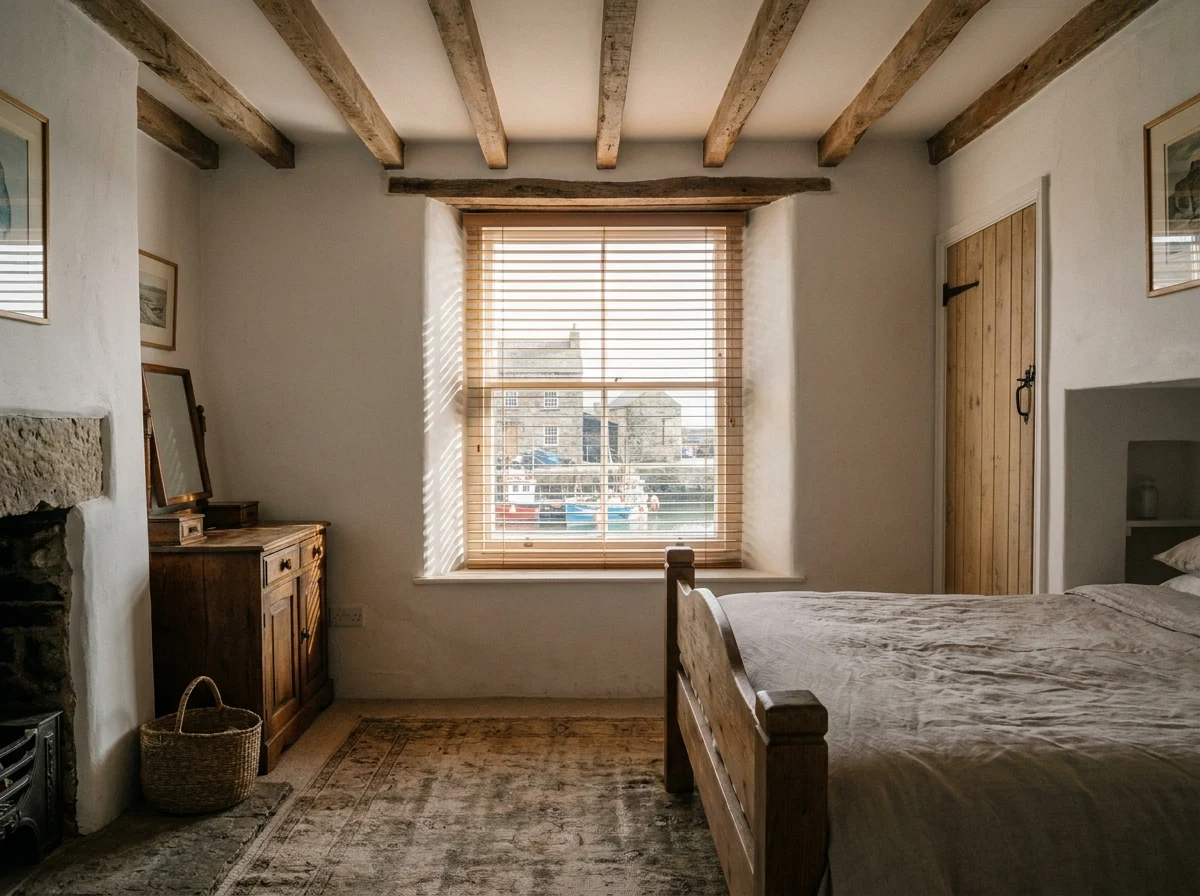
Close to the water, in the older cottages and semi-detached houses on the streets nearest the harbour wall, the dominant nuisance is reflected afternoon light off the bay rather than heat — and the dominant material threat is salt spray on a blustery day. Windows here are often smaller and older, and a warm natural slat in a dry room does more for the character of the house than aluminium would. Wind is present but is not usually the deciding factor this low and this sheltered.
The homes up the slope
Higher up the mountainside the trade is explicit: you buy a long view down the coast and across to the far side of the bay, and you pay for it in wind. Further from the spray, much more exposed to those descending gusts. This is where an unprotected outdoor fitting fails first, and where every external product must be wind-rated, sensor-retracted and fixed into something that has been checked rather than assumed.
The canal frontage
The homes built around the waterways at Harbour Island add a third variable: a sheet of still water immediately off the back deck. Still water is a better mirror than moving water, so a canal-facing room gets its own low, bouncing light from below in the late afternoon — the sort of glare that comes up at you rather than in at you, which conventional advice about “the west-facing window” entirely misses.
Down among the old harbour streets, a warm natural slat in a dry room is often the right call — character kept, reflected afternoon light steered off the wall.Failure modes
The five ways outdoor shading fails here
We get called out to more failed outdoor installations in this town than to almost anything else, and the failures are not random. They fall into five recognisable groups. Understanding them is genuinely more useful than a product brochure, because each one tells you what to insist on.
Flapping fatigue. Fabric that is not held under tension along its edges moves in a gust, and moving fabric wears where it folds — at seams, at the hem, at the bar. Nothing dramatic happens on any single day; the material simply gets tired, and then one afternoon it tears along a line it has been rehearsing all summer. What it teaches: tension along both edges beats a free-hanging edge, every time.
Uplift. An extended awning is a wing. A gust that rolls down the slope and gets under it lifts rather than pushes, and the arms are asked to resist a load in a direction they were not designed around. This is the single commonest cause of a bent arm in an exposed position. What it teaches: in an exposed spot, extended is a temporary state, not a resting one.
Fixing pull-out. Repeated load reversal works fasteners loose in a way steady load never does. Add the wrong anchor for the substrate — a plug meant for solid masonry sitting in hollow block, or a bracket into rendered infill rather than structure — and the product is not what fails; the wall is. What it teaches: the fixing is a bigger decision than the fabric, and it needs a look, not a guess.
Corrosion starting at the fixing. Salt does its worst work at edges, drilled holes and joints between different metals. A beautifully coated aluminium headbox held up by the wrong grade of fastener will show rust streaks long before the box itself is tired. What it teaches: specify the small parts as carefully as the big ones, and rinse them occasionally with fresh water.
The human failure. The most common of all: the awning was left out because nobody was home, or nobody looked up, or it was fine an hour ago. Wind in this town does not build politely over an afternoon; the gusts arrive. What it teaches: automatic retraction is not a luxury item here, it is the difference between a product that lasts eight years and one that lasts two.
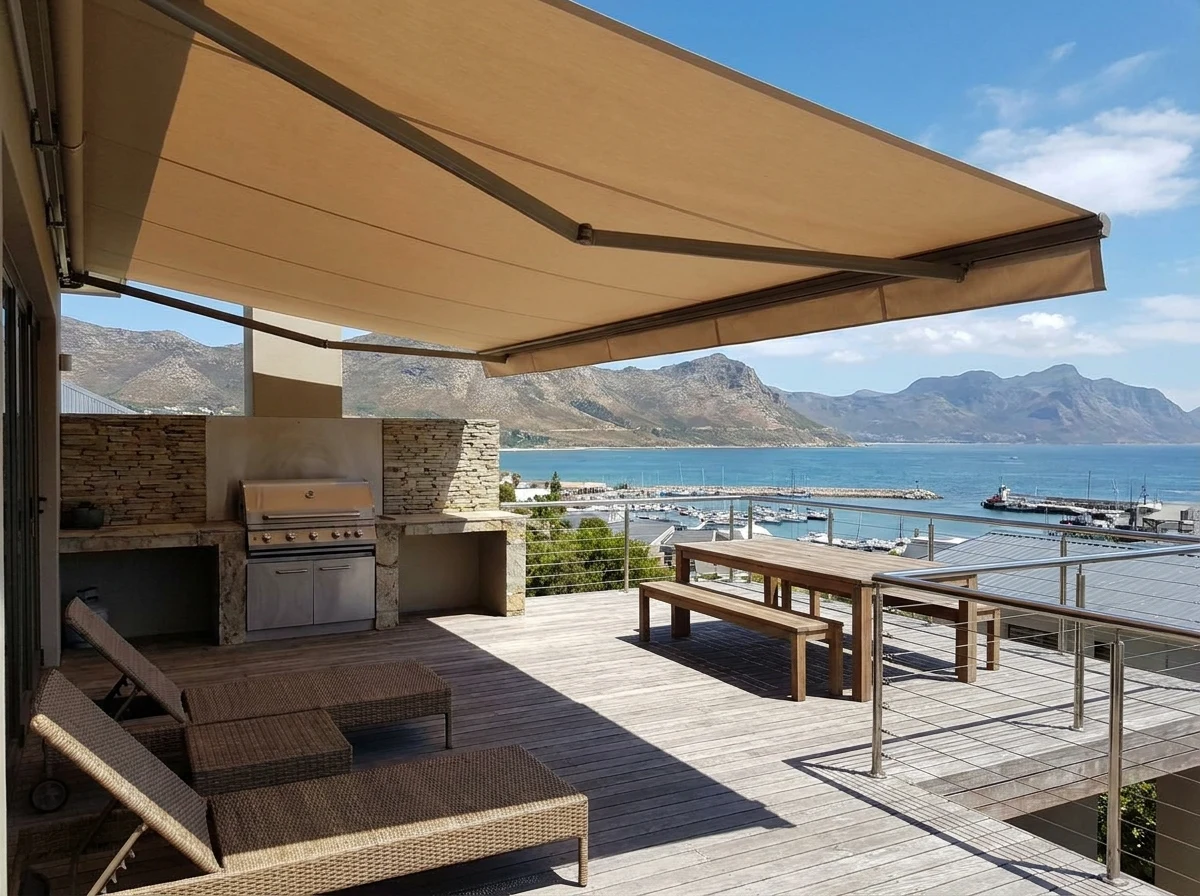
A folding-arm awning over a deck above the harbour. Beautiful extended, vulnerable extended — which is exactly why the sensor and the cassette matter more than the fabric.Ranking
An order of merit for wind
Put the five failures together and outdoor products sort themselves into a fairly clear order for a town like this one. This is our own ranking, based on how these things behave on this coast rather than on any published scale — but we would defend every line of it.
Zip screens. The mesh is held under tension inside side channels, restrained along both vertical edges, so it cannot flap and cannot be lifted. That single design difference answers failure modes one and two outright. On an exposed slope or a wind-swept balcony this is the product we push hardest, and the view through the mesh survives.
Roller shutters. Rigid slats running in guides, rolling into a headbox when not in use. Nothing to flap, nothing to lift, and the whole thing stows out of the weather. Strong on heat and useful on noise as well. Be clear on what it is, though: shading hardware, built for sun, heat and glare, with no security rating attached. If a security product is what you want, say so and we will price that instead.
External venetian blinds. Slats outside the glass that tilt as well as raise, so you can steer a low western beam off the pane and still see under them to the water. They retract fully into their headbox, which is what keeps them in this bracket — on a windy day they simply are not out.
Folding-arm awnings. Genuinely the nicest thing to sit under, and entirely viable here provided it retracts into a closed cassette and carries a wind sensor. Best on lower, more sheltered decks; treat it as shade you deploy rather than a roof you install.
Free-hanging outdoor blinds. An outdoor blind with unrestrained side edges, on an exposed elevation in this town, is a short-term product. We would rather talk you out of one than fit it and be back.
Held in channels down both edges. It is a dull-looking detail and it is the single biggest reason a screen survives a Gordon’s Bay summer.The evening
Killing the evening beam before it lands
Now put the ranking to work on the problem from section two: a low sun crossing open water into your western glass, every evening, all year.
The reason this has to be solved outside the pane is physical rather than commercial. Light that has already passed through the glass is energy inside the room. A fabric behind it can absorb that energy and re-radiate it, but it cannot un-admit it — the pane and the blind both warm up and the room gets it anyway, a little later. Intercept the beam on the outside face and the glass never heats in the first place. On a big west-facing window at six in the evening in January, that difference is not marginal.
What we would put on a west elevation here
External venetian blinds where the view matters and you want control rather than a curtain: tilt the slats and the beam is thrown while the water stays visible underneath. Because they retract entirely, they take nothing away from the same facade in the months when you want the warmth.
Roller shutters where a room is genuinely overheating and you want the most complete answer available — and where the same product will earn its keep again on a winter night by adding a still-air layer over the glass.
Zip screens across a west-facing patio, deck or balcony opening, which is very often the real problem rather than the window itself. They turn an outdoor space that is unusable between five and seven into the best room in the house.
And the honest second-best: where an external fitting is impossible — no fixing available, no consent, no budget this year — a low-openness sunscreen mesh behind the glass will take most of the glare out of the room. It will not do much about the heat, and we would rather say that plainly than let you discover it in February.
Slats outside the glass on a bay-facing wall. Everything they stop, they stop before it becomes the room’s heat.Half down over a patio slider — the most complete of the external answers on heat, and stowed in its headbox when the wind comes up.The other end
Cold rooms at eight in the morning
The mountain that spares you the sunrise also delays your warm-up. A room that lost its sun by mid-evening and did not get it back until the ridge released it can sit cold for a long stretch in winter, and in that stretch the coldest surface in the room is almost always the inside face of the glass.
This is where a cellular honeycomb blind does work no other product does. It is built from cells that hold a layer of still air between the fabric and the pane. Still air is the insulator; the fabric is only what keeps it in place. Closed overnight in the reveal, it slows the heat leaving the room through that cold surface, which is the loss that makes a bedroom or a study feel unwelcoming at seven in the morning.
Two honest limits. It does not tilt, so it manages light and heat but gives you no control over view — it is up or it is down. And it will not fix a room whose real problem is an uninsulated ceiling or a door that whistles; we would rather tell you that than sell you fabric to hide it.
The cells seen half-drawn. That trapped air is the entire product — and it is the one thing that helps a room the mountain keeps in shadow until mid-morning.Salt
How far up the spray really goes
There is a useful distinction to draw here that most coastal advice flattens. Two different things arrive off the sea, and they do not travel the same distance.
Airborne salt — a fine chloride-carrying haze — reaches essentially everywhere in this town, including well up the slope. It is what makes an ordinary fastener bleed rust down a wall in a year, and it is the reason exterior fittings here get marine-grade powder-coated aluminium and a proper grade of stainless in the small parts rather than whatever is in the box.
Actual spray — driven droplets on a blustery day — is a much shorter-range problem. It lands on the streets and balconies close to the water and largely does not reach the houses further up. That matters, because it is spray, not haze, that argues for sealed cassettes and enclosed headboxes rather than exposed tubes.
So the sensible specification is layered rather than uniform. Near the water, seal everything: cassette rather than open tube, enclosed headbox rather than bare brackets, and a fresh-water rinse two or three times a year on anything a hose can reach. Up the slope the hardware grade stays high, because the haze does, but the spend shifts from sealing toward wind rating, fixing quality and sensors — that is what actually fails up there. Everywhere, choose aluminium over natural material in kitchens, bathrooms and any room whose doors stand open to the sea: damp salt air gets into a timber slat and does not come back out.
On site
The questions a measure answers
Everything above can be reasoned from a map, an almanac and twenty years of fixing other people’s wind damage. These cannot:
When your sun actually clears the ridge, and when it actually reaches each west-facing room in the evening. Both are specific to your street and your slope, and both change the answer.
What the wall is behind the plaster at every point where a bracket has to go. This is the single biggest unknown on an exterior job here, and it is not answerable from a photograph.
How exposed your particular corner is. Two houses on the same street can sit either side of a sheltering shoulder. We would rather stand in it than assume it.
Whether the reveal will take an inside fit, measured at three widths and two heights, because older openings near the harbour are rarely square and newer sliders are rarely as deep as they look.
Where power is, and whether a motor can be serviced. A sensor-retracted awning on a high deck is only as good as your ability to reach it again.
That is the honest reason the measure is free and takes as long as it takes. Every one of those five is cheap to establish beforehand and expensive to discover in a south-easter.
Next step
Book your free in-home measure
Tell us your street, how high up the slope you are, and which rooms take the evening sun off the bay. One of our expert consultants will contact you shortly to arrange a free measure with fabric and slat samples in hand.
No obligation, no call-centre — a consultant calls you directly
Fixings and wind ratings checked on site, not assumed
Written, itemised quote before anything is ordered
Sources
Where the facts came from
The geography, the wind behaviour and the solar bearings above all trace to the items below. The order of merit in section five, the five failure modes in section four, and the layered salt specification in section eight are our own professional judgement based on work on this coast — they are opinion, clearly labelled as such, not findings.
Wikipedia — Gordon’s Bay: the town’s position in the north-eastern corner of False Bay at the base of the Hottentots-Holland mountains, and its small-craft harbour.
Wikipedia — False Bay: the extent of the bay, roughly thirty kilometres across, bounded by the Cape Peninsula on its western side and the Hottentots-Holland on its eastern.
Sailboat Liveaboard — Gordon’s Bay sailing and cruising guide: the summer south-easter at Gordon’s Bay blowing from the mountain and shore toward the west or north-west, the harbours lying on the lee side of the range, and gusts descending through the mountain valleys and shifting direction in the harbour approaches.
Gaisma — Cape Town sun and moon data: sunset bearing near 240° and elevation at 12:00 near 75° at the December solstice; sunset bearing near 297° and elevation at 12:00 near 31° at the June solstice. The altitudes used on this page are derived from the latitude and the ±23.44° declination at true solar noon; the source's own are clock readings at 12:00.
Nothing on this page is a structural, engineering or wind-loading assessment — a fixing into a specific wall is a job for a look on site and, where it matters, a suitably qualified professional. The guide is free, and reading it puts you under no obligation at all.
Download a copy to share with whoever else has a say in the windows.